Home Back Fading but Not Dying: Mak Yong Performances in the Three Southern Border Provinces Await Continuation
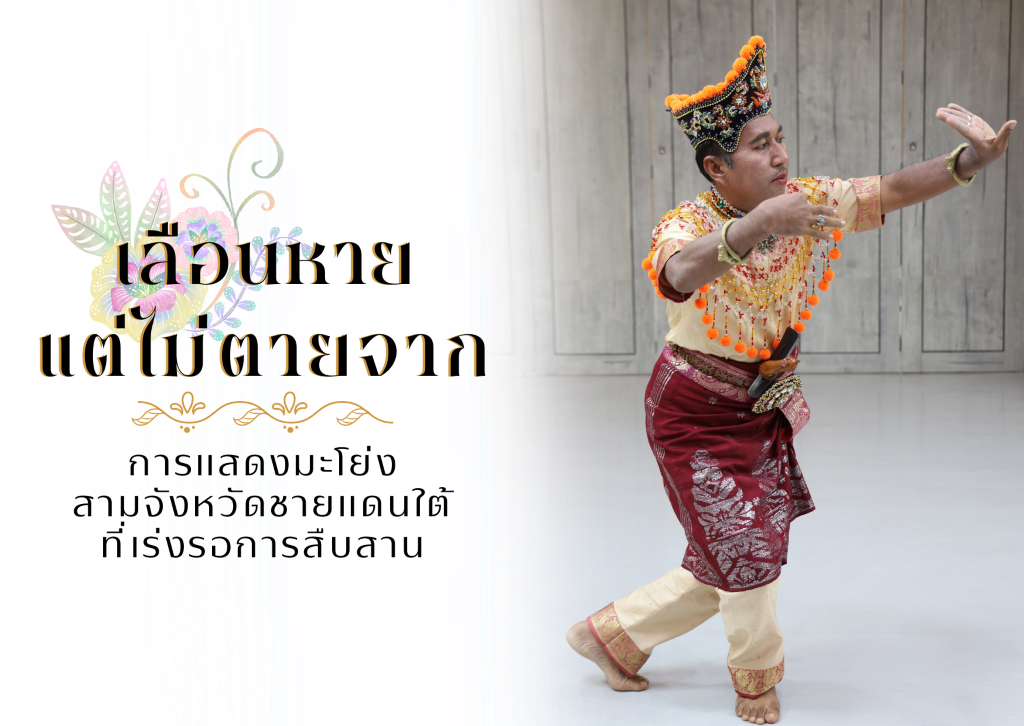
Fading but Not Dying: Mak Yong Performances in the Three Southern Border Provinces Await Continuation
Suteera Boontum1
Patani Malay chants and the sound of rebab have echoed through the Malay Peninsula for over 400 years, but as modernity spread, these sounds have grown quieter. The vibrant colors of the costumes and the lively dance moves of the Mak Yong performance is fading into darkness as is the glimmer of hope that the descendants near the southern border will turn around and continue it.
Is “Mak Yong,” an ancient performance that was associated with the Pattani court and the Malay Peninsula, truly slipping from the memory of southerners?
Mak Yong on the Malay Peninsula in the Past
.png)
A Mak Yong show by the People of Khok Pho District, Pattani Province During the Reign of King Chulalongkorn (Rama V) Retrieved from https://archive.clib.psu.ac.th/online-exhibition/mak%20yong/Mak Yong2.html
The “Malay Peninsula” is an area where Hindu-Javanese beliefs are prevalent in the three southern provinces of Thailand??, the northern border provinces of Malaysia, and some areas of Indonesia. The Malay Peninsula has shaped the "Mak Yong" performance with a blend of dance, ritual, and music imbued with magic. The origins of Mak Yong are diverse and unclear. According to the Encyclopedia of Southern Thai Culture, Volume 12 (1999, pp. 5934-5935), some believe that Mak Yong was born from the worship of rice, while others think it originated from the Java Islands. However, Pattani Malay songs provide crucial evidence for Malaysian scholars to conclude that Mak Yong originated in Pattani. This view aligns with Mr. Saman Dosomi (2024, interview), Chairman of the Chalermraj Cultural Center at Kue Meng Folk Museum, who stated that Mak Yong originated during the Pattani Kingdom and flourished 400 years ago. It shares the same roots as the Manorah or Chatri drama, which were once popular in the royal court.
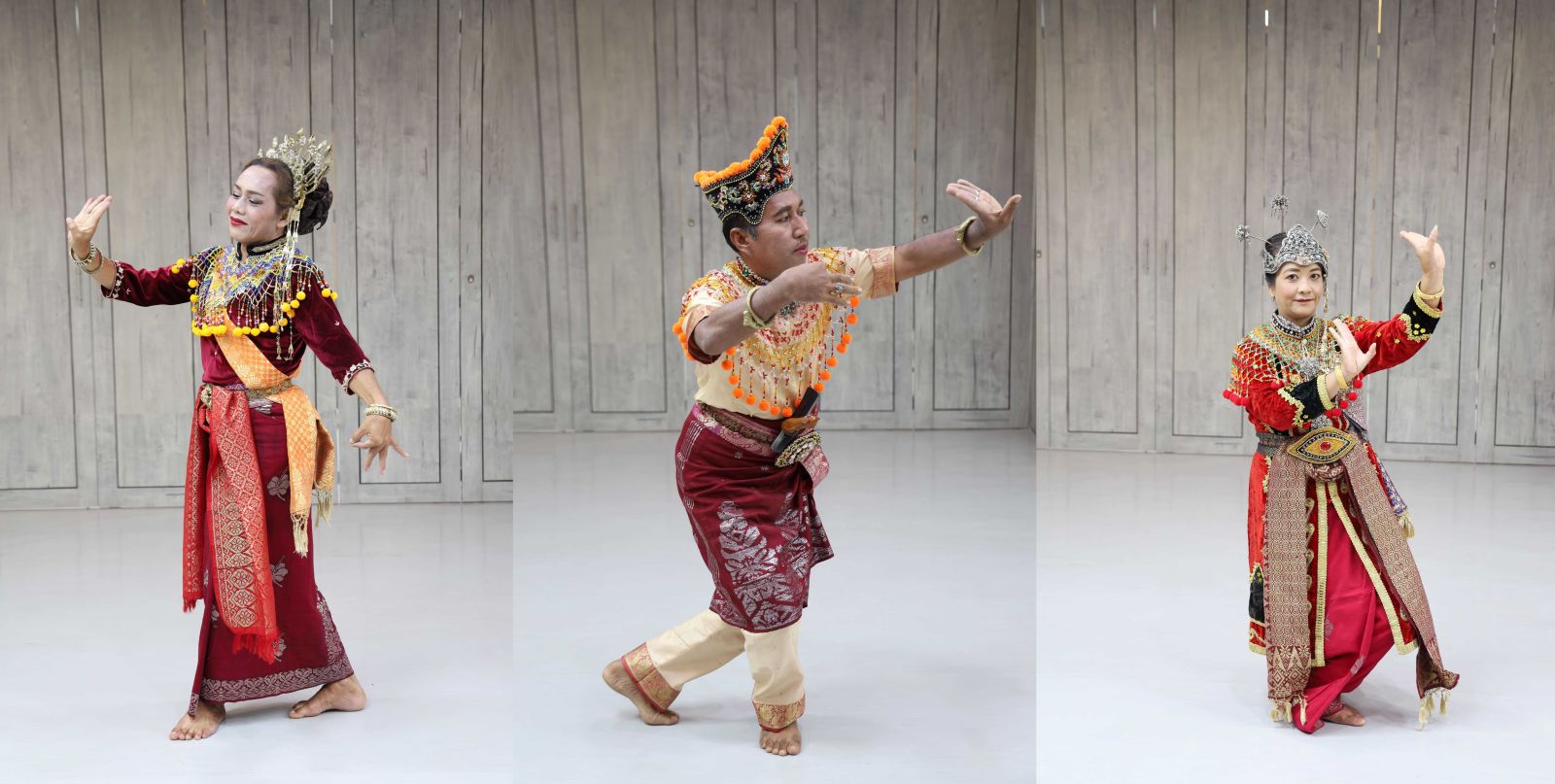
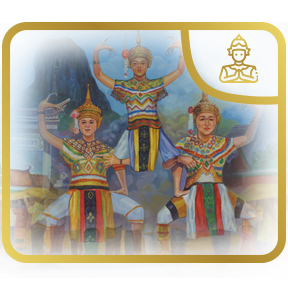
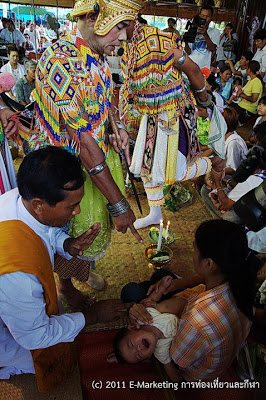
Payong or the protagonist (center) and Mak Yong or the heroine (left and right)
Professor Saman Dosommi further said that Hindu and Javanese cultures influence the Mak Yong performance in every aspect such as the costumes, musical instruments, and belief rituals. Mak Yong is both a popular entertainment and a cultural offering. It showcases stories from fairy tales and dramas, featuring characters like Payong (the hero) and Mak Yong (the heroine), Tua Phue Rae (the clown), and Dayang-dayang (the servant). Performers wear bright costumes and flashy jewelry. The heart of Mak Yong performances is the "Rabab," a musical instrument accompanied by Thai drums, a double mong, Javanese gongs, and a Javanese oboe, reflecting Hindu and Javanese cultural influences. According to Phinyo Wechacho (2014, p. 25), the Mak Yong performance integrates Hindu-Javanese beliefs as seen in Pa Yong's attire with a Javanese dagger representing Lord Shiva's weapon, and rubab, which symbolizes "Gunung" or Mount Meru, a common belief in Brahmin-Hindu religions.
.png)
.png)
seorubab and javanese oboe
.png)
.png)
.png)
Malay drums, gongs and double mong
.png)
cheore(left) ching(right) chap (bottom right)
In the 19th century, the arrival of Islam marked a turning point for the people of the area. Islam influenced every aspect of life including lifestyle, culture, and religious beliefs. As a result, the popularity of the Mak Yong performance declined because it conflicted with Islamic principles. According to Nuriyan Salae (1997, pp. 95-120), one of the key factors contributing to the decline of the Mak Yong was the arrival of Islam. However, Islam does not prohibit humans from creating culture or pleasure, but it must be within the framework of the religion's beliefs. The performance of Mak Yong goes against the principles of Islam in four ways: 1) the use of incantations related to ghosts, spirits, or sacred objects; 2) the use of sweet and savory offerings in the opening ceremony; 3) the belief that the musical instruments are haunted by spirits; and 4) stories or melodramatic tales that are fantasies. All of this has led to the determination of Mak Yong academics and performers to be willing to adjust their performances to suit the current social conditions. The results, on the other hand, were not very satisfactory.
Thai-Malay Mak Yong Performance without borders
.png)
.png)
Mak Yong drama and dance in Penang around 1903
Retrieved from https://th.wikipedia.org/wiki/%E0%B8%A1%E0%B8%B0
%E0%B9%82%E0%B8%A2%E0%B9%88%E0%B8%87
Back in the days when the Malay Peninsula encompassed the three southern border provinces of Thailand and the northern part of Malaysia, people freely moved between these regions. This movement allowed cultures to blend and transfer, creating what can be called a 'borderless culture.' This cultural exchange helped spread the Mak Yong performance to Malaysia. According to Mr. Saman Dosomi (2024, interview), Thai Mak Yong performers traveled to Malaysia and shared their art, leading to its growth and popularity there. If any side had a performance, performers would frequently join in and assist each other. This collaboration continued until 2001 when UNESCO registered Malaysia's Mak Yong as an oral masterpiece and a non-physical cultural heritage of humanity. Despite this recognition, Malaysian authorities have always acknowledged and respected the origins of the Mak Yong performance. They have also worked alongside Thailand to restore and conserve this cultural tradition. However, the Mak Yong performance in Malaysia faces challenges because it conflicts with the principles of Islam, the state religion of Malaysia.
The Restoration and Conservation of Mak Yong: a Decision the Government must Urgently Make.
.png)
Interview with Professor Saman Dosomi, Assoc. Prof. Dr. Rewadee Ungpho, and a Mak Yong performer on February 15, 2024 at the Thai Music Room, Faculty of Liberal Arts. Prince of Songkla University Hat Yai Campus
When reflecting on Thailand's efforts for restoration and conservation, reviving the Mak Yong performance is seen as an urgent task. Government assistance is crucial to address this issue effectively, according to Assoc. Prof. Dr. Rewadee Ungpho and Mr. Saman Dosomi (2024, interview). They noted that Mak Yong performances have diminished to ritualistic forms, which may conflict with religious principles. The performance format has been adapted to align with current trends, and efforts are being made to incorporate the Mak Yong performance into educational curricula by engaging various educational institutions. However, the efforts of a single person are not enough to revive the Mak Yong performance to be popular among the southern people. Government involvement is essential at the proactive policy level for restoration and conservation. Besides governmental policies, “indoctrination” plays a crucial role in making the new generation aware of the profound value of the Mak Yong performance, something that cannot be fully taught in educational institutions. Therefore, restoration and conservation should not be solely the responsibility of the current performers or those who continue the Mak Yong performance. All southerners must be involved in bringing the Mak Yong performance back to the forefront of public attention.
Although times have changed and our beliefs have evolved, the results of these changes might be the key to bringing Mak Yong back to its former splendor. As long as the children of the South and the government recognize the importance of this performance, Mak Yong will keep evolving, adapting, and eventually reclaiming its place in society’s spotlight.
1An Applied Thai Program student, Faculty of Liberal Arts, PSU (cooperative education at the Self-Access Learning Center)
Nuriyan Salae. "Mak Yong." In Encyclopedia of Thai Culture, Southern Region, Volume 12, 5934-5935. (1999).
"Mak Yong: A Fading Attempt to Preserve Culture." In Cultural Perspective: Collection of Academic Articles on Cultural Studies, 95-120. (1997).
Phinyo Wechacho. Research report on Mak Yong: Malay dance. Yala: Yala Rajabhat University, 2014.
Aldullah Mahama. Yalo, Yala, Community Ties That Preserve Local Wisdom. Pattani: Prince of Songkla University, 2014.
Share 4720 view

 ภาพฟรี.png)
.jpg)
.png)